Series
Ad creative
Hook rate, hold rate, creative fatigue, and how to test ads without fooling yourself about the winner.
30 articles so far, in the order they were written.
Then, in order
-
What replaces promote and kill, once you stop doing it
A creative testing framework built around supplying options rather than judging them, with the four decisions that still belong to you.
Read -
The right number is decided by your budget, not your ambition
How many ads to test depends on spend per creative, not on a rule of thumb. Here are the bands that work and the arithmetic behind them.
Read -
At your budget you will never reach it, and that is fine
Statistical significance in ad testing is unreachable at most real budgets. Three worked examples, and what to do instead of pretending otherwise.
Read -
Make the pond smaller instead of making fewer ads
Creative testing on small budgets works if you shrink the audience rather than the creative count. Here is the adjustment and why it beats the usual advice.
Read -
Half of everything you make will receive almost no spend
Creative volume guidance by monthly spend, and the winner rate that explains why. Half of all ads get little or no delivery, and that is normal.
Read -
Every number you have been given for it was invented
Hook rate has no published benchmark from any source with a disclosed method. I do not track it, and here is what I watch instead.
Read -
If they stayed, the opening already did its job
Hold rate is the video metric I actually track: more than half viewed and past three seconds. It contains the hook measurement without needing it.
Read -
Six numbers, and the denominators nobody checks
Ad creative metrics disagree because they divide by different things. Six of them, what each denominator does, and the account that proved the point.
Read -
One name, three calculations, and nobody says which they used
Thumbstop rate is calculated three different ways depending on who is talking. Here are all three, and why comparing them is meaningless.
Read -
Four numbers everybody quotes, traced back to nothing
Four creative benchmarks the industry repeats constantly, traced to their origins. One is a 2016 blog post. One was deliberately never published.
Read -
Meta defines it, and the definition is about cost not frequency
Creative fatigue has exactly one defined threshold and Meta wrote it: cost per result at twice its previous level. Everything else circulating is invented.
Read -
Meta measured it across 2,439 campaigns and published no number
Ad frequency thresholds have no published source. Meta studied 2,439 campaigns and declined to name one, while the industry names several.
Read -
Replace on the number, produce on the calendar
Creative refresh cadence should follow spend and measured cost, not a fortnightly rule. Here are the production bands and the replacement trigger.
Read -
Name the problem and hand over the solution in one breath
Ad angles that work do not look like adverts. Two I have run, written out, plus the structure underneath them and where to find more.
Read -
Your customers already wrote the copy, in five places
Voice of customer research means lifting the exact words people already use. Five sources, what each one gives you, and how to turn it into copy.
Read -
Eight structures that still work, and the ones that give you away
Ad copy formulas worth keeping, plus the patterns that mark copy as written by a machine or a template. Eight structures and what each one is for.
Read -
Under twenty characters halved the cost per acquisition
Ad headlines under twenty characters produced roughly half the cost per acquisition of longer ones across 20,000 accounts. Sentence case beat title case.
Read -
Five rules, one page, and the argument at the top
A creative brief for ads that fits on one page. Five design rules I always specify, and why the argument belongs above every constraint.
Read -
Nobody has published a study showing they beat studio work
UGC ads are recommended everywhere and no study with a disclosed sample supports the premium. Here is what the evidence does and does not show.
Read -
Give them the argument and let them sound like themselves
Briefing UGC creators works when you specify the argument and leave the delivery alone. Five rules, and the over-direction that removes the point.
Read -
The comparison everybody asserts and nobody has run
Static vs video ads is argued with percentages that have no source. Here is what the absence means and how to answer it in your own account.
Read -
One range clears every documented placement requirement
Video ad length between five and fifteen seconds qualifies for every documented Meta placement. Here is why that range is the practical default.
Read -
The most repeated statistic in paid social is a myth
Sound off video ads are real and the famous 85% figure is a myth from a 2016 blog post. Here is the sourced number to use instead, and what to do.
Read -
Real research, measured on something that is not your account
Creative drives sales rests on real research measuring supermarket brand advertising on purchase panels. Here is what transfers and what does not.
Read -
What you pay to be seen is partly your own doing
Creative and CPM are connected through response, not through quality scores. Here is the mechanism, and the account where cheap reach cost the most.
Read -
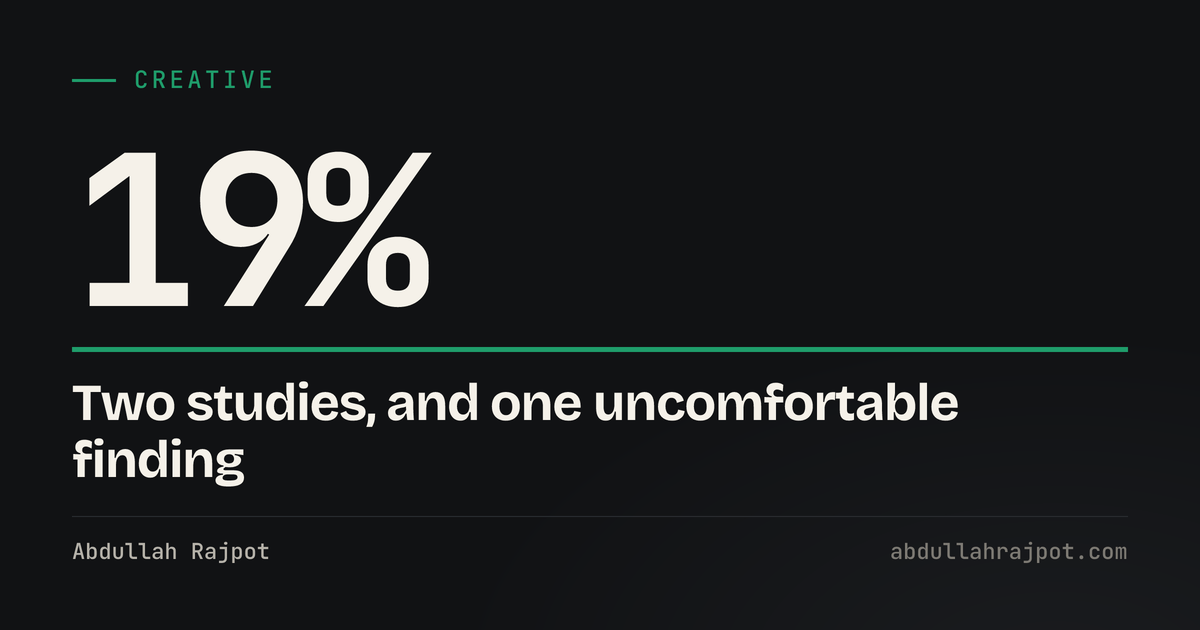
It works, and saying so out loud costs you the gain
AI generated ad creative lifted click-through by up to 19% in one study. Disclosing the AI involvement reduced effectiveness by up to 31.5%.
Read -
Google's guidance and the largest dataset disagree
Responsive search ads pit Google's own guidance against 20,000 accounts of independent data. Here is what each says and how to act on both.
Read -
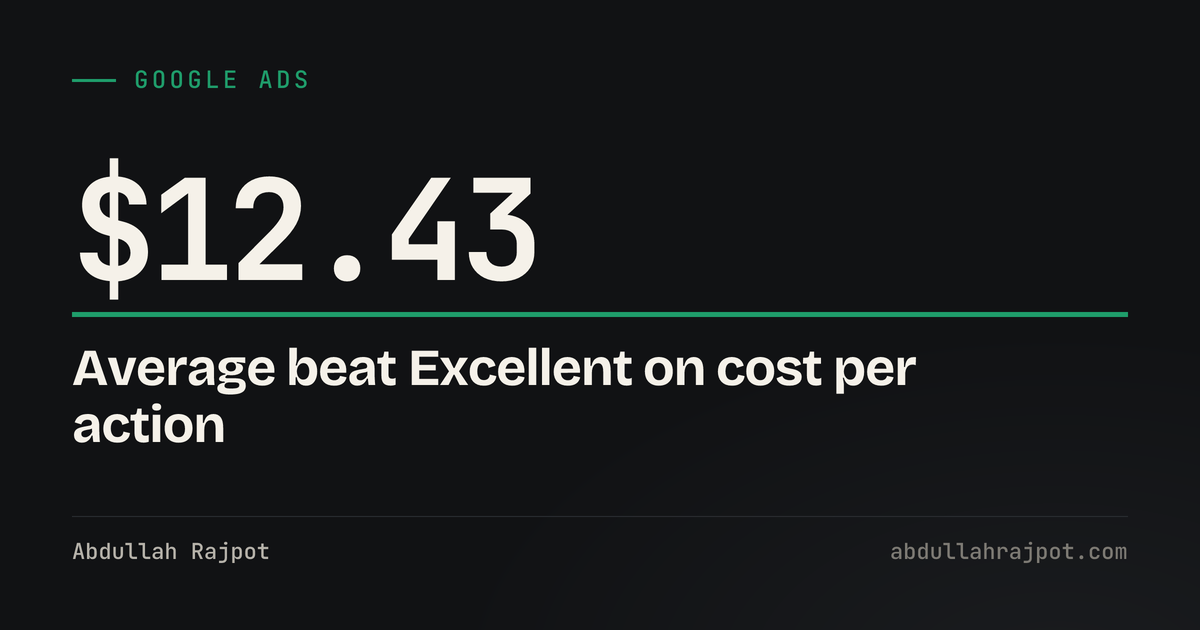
Average beat Excellent on cost per acquisition
Google Ad Strength rated Excellent produced the worst cost per acquisition across 20,000 accounts. Average produced the best. Here is what to use instead.
Read -
When the platform edits your ads, you stop knowing what you tested
Automated creative changes your adverts after you upload them, so what performed is not always what you made. Here is what that does to testing.
Read


Book a free teardown
Send me your worst-performing campaign.
I will tell you what is wrong on the first call. No obligation, no hard sell, and I will say honestly if I am not the right fit.
Book a free 20-minute account teardownReplies within one business day, Lahore time.